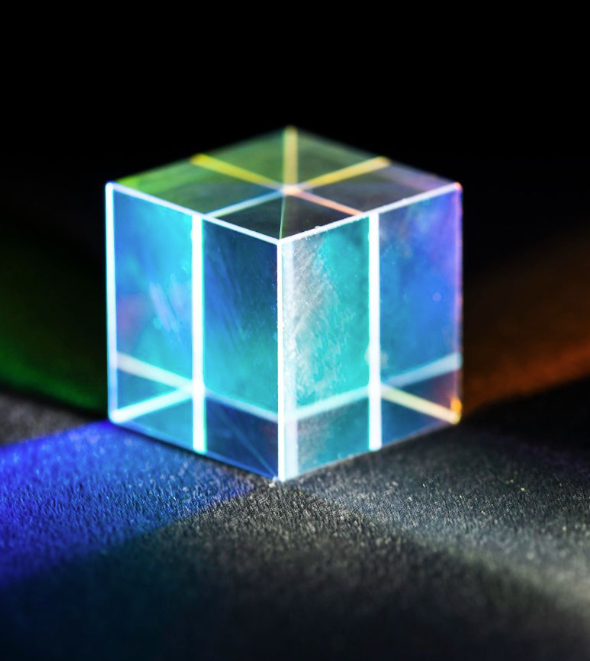
Intro to Optics
About this free Intro to Optics course
Intro to Optics is a free physics course about light: what it is, how it behaves, and how we use it. Designed to make physics engaging and accessible, the curriculum shows how waves carry energy, why polarized sunglasses cut glare, how microscopes, telescopes, and cameras focus light (and where their resolution runs out), and how lasers work through stimulated emission.
Every lesson connects physics principles to technology you already use, including LCD screens, 3D movie glasses, camera filters, fiber-optic internet, and solar panels. The course moves from wave optics and polarization to modern optics, covering photons, quantum light, and wave-particle duality. It closes with review activities, including multiple-choice, true/false, and concept matching, to lock in what you've learned. It's built for students and educators alike.
Who this course is for
The course is designed for high school students in grades 9 through 12 and for curious middle schoolers. You'll need basic Algebra 1 and some familiarity with scientific notation. No previous physics class is required.
Course outline
- Unit 1: Wave optics. The nature of light, characteristics and types of waves, and wave parameters such as wavelength and frequency.
- Unit 2: Polarization. What polarization is, refraction in a prism, linear, circular, and elliptical polarization, and everyday applications.
- Unit 3: Optical instruments. How microscopes, telescopes, and cameras work, and the limits of resolution.
- Unit 4: Properties of light. The speed of light, intensity, absorption, and scattering (and why the sky is blue).
- Unit 5: Modern optics. Photons and energy, lasers and stimulated emission, wave-particle duality, and basic quantum light.
- Review. Multiple-choice, question-and-answer, true/false, and concept-matching activities.
What you'll learn
- Describe light as both a wave and a particle
- Explain polarization and where it's used in everyday technology
- Describe how lenses in microscopes, telescopes, and cameras form images
- Explain absorption, scattering, and intensity
- Describe how lasers produce coherent light
How long it takes
Plan on about 8 hours, or roughly 90 minutes per unit, including the review activities at the end.
Frequently asked questions about Intro to Optics
Is Intro to Optics really free?
Yes. Intro to Optics is completely free, with no fees, subscriptions, or account required. STEM for Others is a 501(c)(3) nonprofit, and every course in our curriculum library is free for students, families, and teachers.
Do I need to know calculus for this course?
No. Intro to Optics is conceptual and uses only basic algebra. It's a great companion to Physics 2 for students preparing for AP Physics 2.
How do I start the course?
Click Begin Course at the top of this page to open the full slide deck in a new tab. You can also flip through the slides embedded above. Work through one unit at a time and try the practice questions before moving on.
Do I get a certificate?
The self-paced Intro to Optics materials don't include an official certificate. If you're taking the course through a STEM for Others chapter program, ask your chapter leader about recognizing your completion.
Can teachers and clubs use this curriculum?
Yes. Teachers, homeschool families, libraries, and after-school clubs are welcome to use the Intro to Optics materials with their students at no cost. STEM for Others volunteers also teach our curriculum in partner schools and libraries. You can find a chapter near you or start one at your school.
Related free courses
Related free webinar
Watch NASA Exoplanets, a free STEM for Others webinar, to explore how scientists find planets around other stars. Browse all free STEM webinars.