Science and Math Competitions for High School Students (2026–27)
Updated on
October 26, 2026
STEM competitions are one of the best ways to push yourself past what you learn in class. They also connect you with students who love the same subjects, and strong results can stand out on college applications.
This guide covers the major science and math competitions for high school students in the U.S., how each one works, and when to sign up for the 2026–27 season. It's written by student volunteers at STEM for Others, a nonprofit that offers free competition prep courses in math and physics.
Quick list
- AMC 10 / AMC 12 (math): November.
- F=ma (physics): winter; February in 2026.
- USABO Open Exam (biology): late January or early February.
- USNCO Local Exam (chemistry): late February to mid-March.
- Science Olympiad (team science and engineering): regionals in winter and spring.
- Regeneron ISEF (independent research): qualify through local fairs; finals in May.
- Congressional App Challenge (coding): submissions due in October.
Math
AMC 10 and AMC 12
The American Mathematics Competitions, run by the Mathematical Association of America, are the first step toward the USA Mathematical Olympiad. The AMC 10 is for students in 10th grade and below, and the AMC 12 is for students in 12th grade and below. Each is a 75-minute, 25-question multiple-choice exam. In 2026, the A version is on November 5, with the B version the following week.
Top scorers qualify for the AIME in February, and top AIME scorers advance to the USAMO or USAJMO in March. Schools register for the AMC, so ask your math teacher.
Prepare with: our free Competition Math course and past AMC problems.
Physics
F=ma and USAPhO
The F=ma exam is the first round of the U.S. Physics Olympiad, run by the American Association of Physics Teachers. It's 25 multiple-choice questions in 75 minutes, focused on algebra-based mechanics. Top scorers are invited to the USAPhO, a calculus-based free-response exam, and the best USAPhO students go on to a training camp for the International Physics Olympiad. The 2026 F=ma was held February 12, so expect a similar date in 2027.
Prepare with: our free Competition Physics course, built specifically for the F=ma exam.
Chemistry
U.S. National Chemistry Olympiad (USNCO)
The American Chemical Society runs the USNCO through its local sections. Students take a local exam, usually from late February to mid-March, and top scorers advance to the national exam in April. The best national scorers attend a study camp to select the U.S. team for the International Chemistry Olympiad. Find your ACS local section to register, usually through a chemistry teacher.
Prepare with: our free Intro to Chemistry and Intermediate Chemistry courses.
Biology
USA Biology Olympiad (USABO)
The USABO, run by the Center for Excellence in Education, starts with an online Open Exam, usually in late January or early February. Top scorers take a Semifinal Exam, and finalists attend the in-person National Finals. Schools register students in the fall, typically by early November, so talk to your biology teacher soon.
Prepare with: our free Intro to Biology and Intermediate Biology courses.
Research and engineering
Regeneron ISEF
The Regeneron International Science and Engineering Fair is the world's largest pre-college science competition. You can't apply directly: you qualify by winning at an ISEF-affiliated regional or state science fair. Finals are held each May. Start your project in the fall to be ready for winter and spring fairs.
Regeneron Science Talent Search
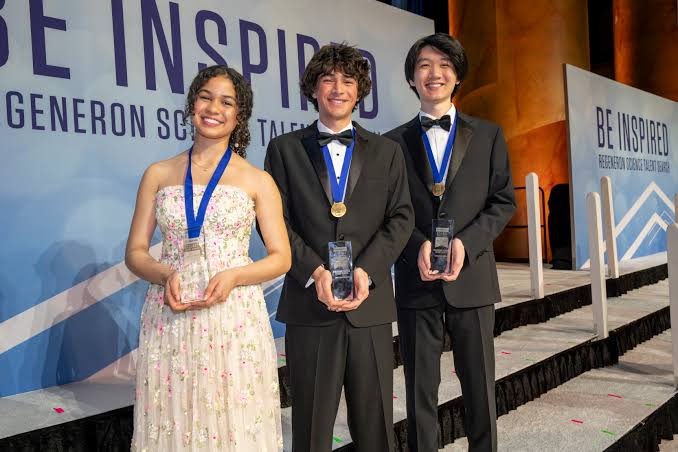
The Science Talent Search is for high school seniors who have done original research. Students submit a research report and a detailed application in the fall of senior year, so most finalists begin their research one or two years earlier.
Science Olympiad
Science Olympiad is a team competition with events across biology, chemistry, physics, earth science, and engineering, including build events like bridges and flying devices. Teams compete at regional, state, and national tournaments. If your school doesn't have a team, it's a great club to start.
Computer science
Congressional App Challenge
Members of the U.S. House hold this coding competition for middle and high school students in their districts. You submit an app you built, usually by late October, and district winners are recognized in Washington, D.C. The 2026 deadline was October 26, so plan for fall 2027.
USA Computing Olympiad (USACO)
USACO runs online contests during the school year, where you solve algorithm problems in languages like Python, Java, or C++. You move up from Bronze to Silver, Gold, and Platinum divisions. If you're new to coding, start with Intro to Python or Intro to Java.
How to choose a competition
- Pick the subject you'd study anyway. Competition prep takes months, and enjoying it makes all the difference.
- Start with one. It's better to go deep in one competition than to sit every exam unprepared.
- Check registration early. Many competitions require your school to register you, often months before the exam.
- Don't wait until you're "ready." Most students take the AMC or F=ma for the first time to see what it's like.
Frequently asked questions
What are the most prestigious high school science competitions?
The olympiads (USAMO, USAPhO, USNCO, USABO), Regeneron ISEF, and the Regeneron Science Talent Search are among the most recognized.
Can I take a competition if my school doesn't offer it?
Often yes. Many competitions let students register through another school, a local organization, or an approved testing center. Check the competition's website for options.
Do science competitions help with college admissions?
Strong results can stand out, especially at the national level. But taking part and improving over several years also shows real interest in a subject.
What competitions can middle school students do?
The AMC 8, MATHCOUNTS, Science Olympiad (Division B), and the Congressional App Challenge are all open to middle school students.